

The Hidden Knowledge Problem
Every organization has knowledge that exists only in people’s heads:Institutional Knowledge
“We never count demo units as inventory”Unwritten rules specific to this organization
Experiential Knowledge
“We tried that approach in 2019, and it doesn’t work with our suppliers”Learned through doing, never documented
Operational Knowledge
“Sales from the Miami branch always come in a day late”How things actually work day-to-day
The Three-Level System
Superatom captures tribal knowledge at three levels, each with different scope and application:Level 1: Global Knowledge
Scope: Applies to every query for every user Purpose: Organization-wide definitions, rules, and conventionsExamples
How It Works
Without global knowledge, “Q3” might be interpreted as calendar Q3 (Jul-Sep) instead of fiscal Q3.Level 2: User Knowledge
Scope: Applies to queries from specific users Purpose: Role-based views, personal preferences, access restrictionsExamples
How It Works
The same question from a different user would show different data based on their knowledge nodes.Level 3: Query Knowledge
Scope: Applies to specific types of questions Purpose: Define business terms, calculation methods, domain-specific logicExamples
How It Works
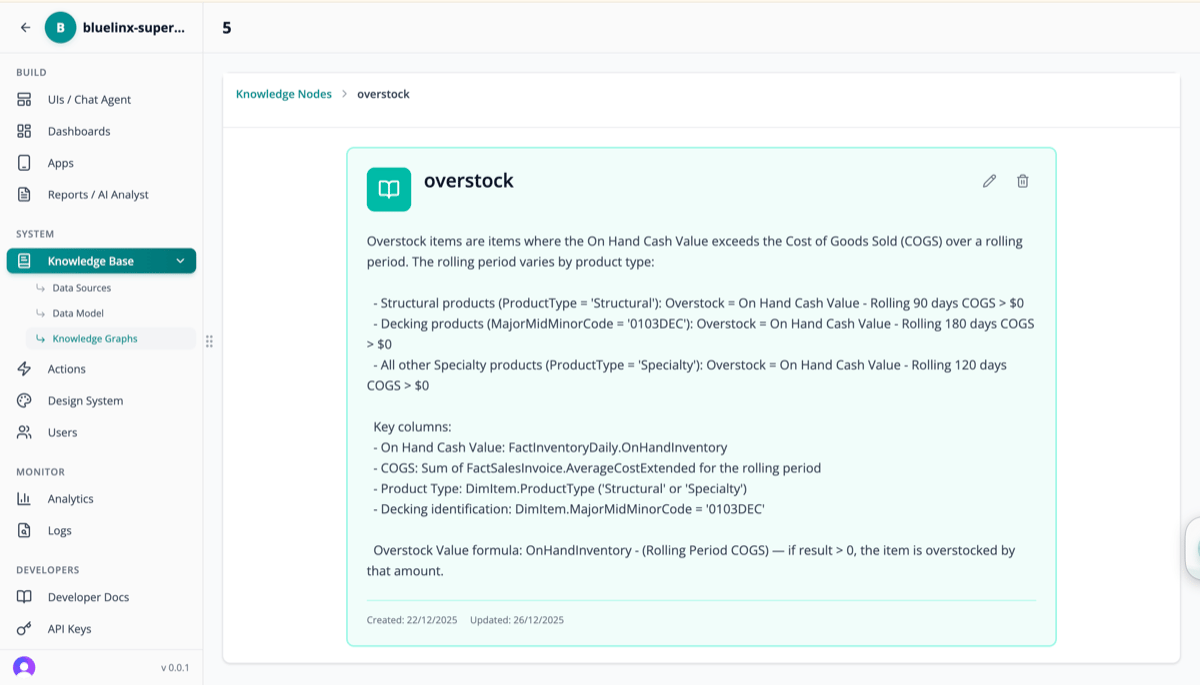
Knowledge Node Structure
Each knowledge node contains:The Knowledge Graph
Knowledge nodes connect to form a graph that captures organizational understanding: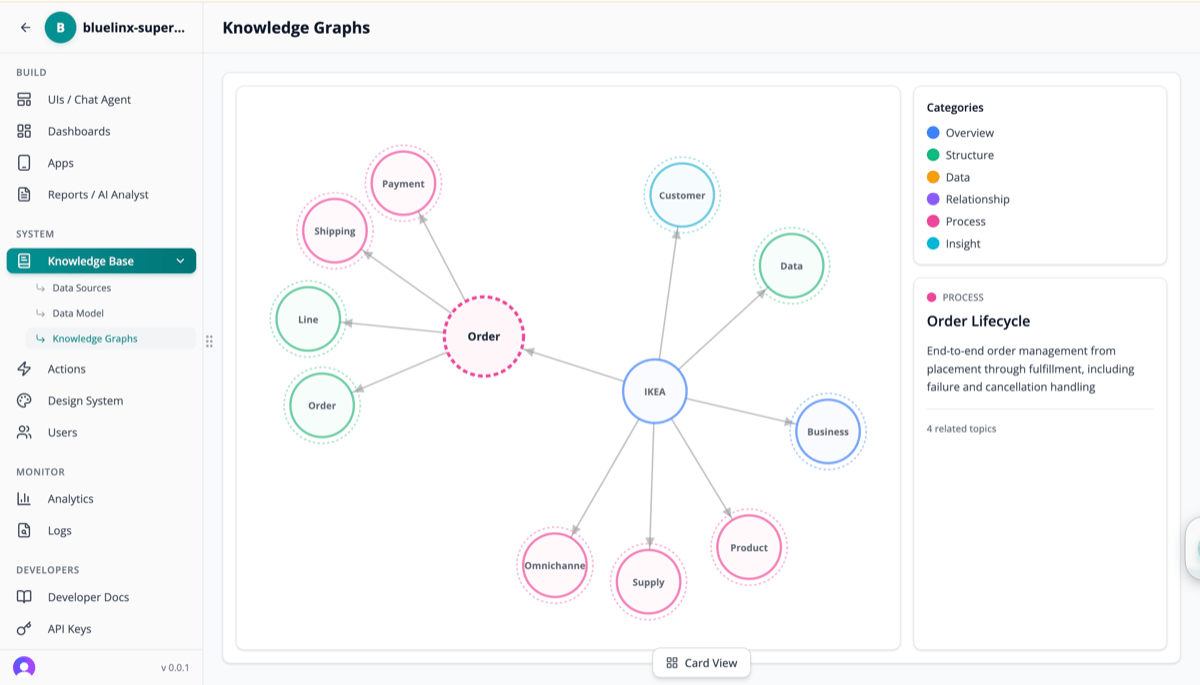
- Relationship traversal - Understanding how concepts connect
- Context inheritance - Child nodes inherit parent knowledge
- Conflict resolution - More specific nodes override general ones
Creating Knowledge Nodes
From the UI
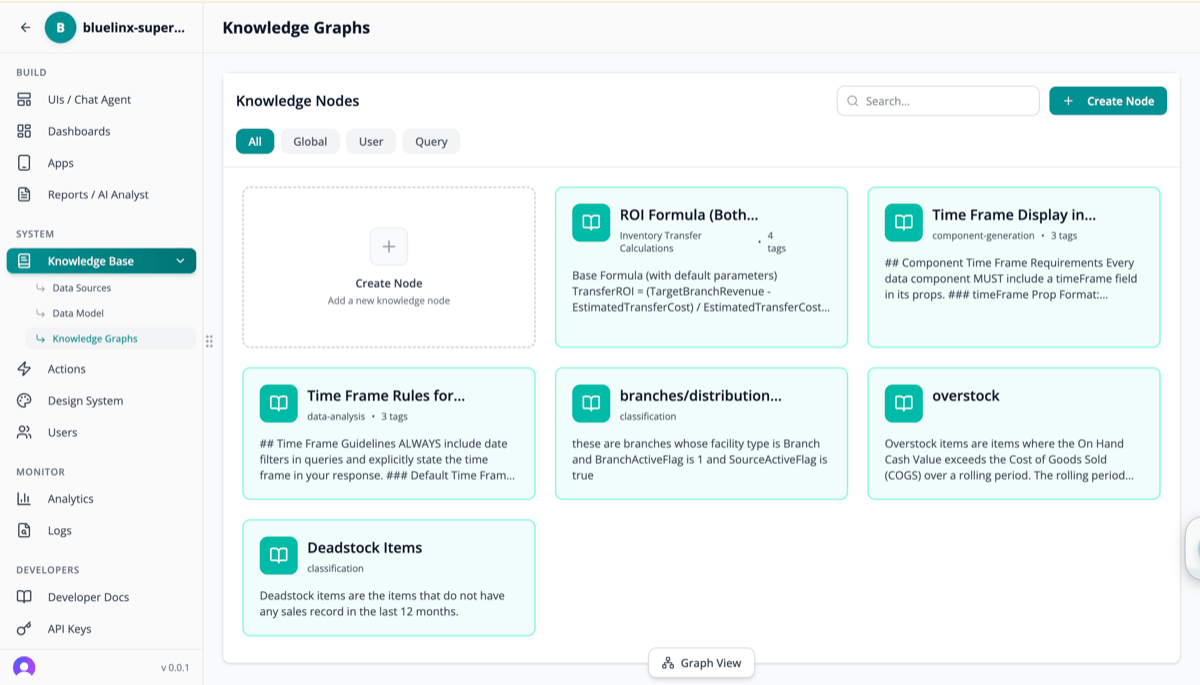
- Navigate to Knowledge Base → Knowledge Graphs
- Click + Create Node
- Select level (Global, User, Query)
- Define trigger conditions
- Add description and rules
- Save and test
From Conversations
When the AI gives an answer that needs organizational context:- User corrects: “Actually, we don’t count returns in sales”
- System prompts: “Would you like to save this as a rule?”
- User confirms scope (global, user, query)
- Knowledge node created automatically
How Knowledge Flows
Priority Order:- Query-level knowledge (most specific) wins
- User-level adds personal/role context
- Global-level provides baseline rules
Why This Matters
The Problem with Generic AI
Business Impact
Accuracy
Answers reflect how YOUR organization actually works
Consistency
Same terminology means the same thing for everyone
Onboarding
New employees get organization-aware AI from day one
Knowledge Preservation
Institutional knowledge survives employee turnover
Curating for Any Domain
The Tribal Knowledge system allows Superatom to be curated for any industry and any organization:- Supply Chain
- Retail
- Finance
- Healthcare
- Lead time calculations
- Safety stock formulas
- Supplier rating methods
- Logistics cost allocation
Next Steps
Knowledge Base Platform
Managing knowledge in the platform
Coding Agents
How agents use tribal knowledge