BlueLinx Holdings is a U.S.-based wholesale distributor of residential and commercial building products, offering materials like lumber, siding, millwork, and engineered wood through a broad network of distribution centers. Headquartered in Marietta, Georgia, the company serves national home centers, pro dealers, specialty distributors, and industrial manufacturers with value-added services and supply chain solutions.

The Challenge

BlueLinx operates 64 branches with 356M+ in on-hand inventory. The core problem:
  • 12M+ in deadstock, inventory with no sales in 365+ days across 57 branches
  • The problem wasn’t just identifying dead stock, but figuring out where to send it so it generates ROI instead of sitting in branches with no demand
  • Manual analysis across 64 branches was impractical at scale

The Approach

  • Agentic AI for intelligent deadstock identification and demand analysis
  • Mixed Integer Linear Programming (MILP) for optimal transfer route selection, evaluating demand, distance, and freight cost simultaneously
  • Merging AI + domain-specific supply chain optimization algorithms to make decisions that a general-purpose AI cannot

The Outcome


Walkthrough

1. Inventory Intelligence Dashboard

Real-time KPIs across 64 branches: revenue, orders, inventory, and margins at a glance.
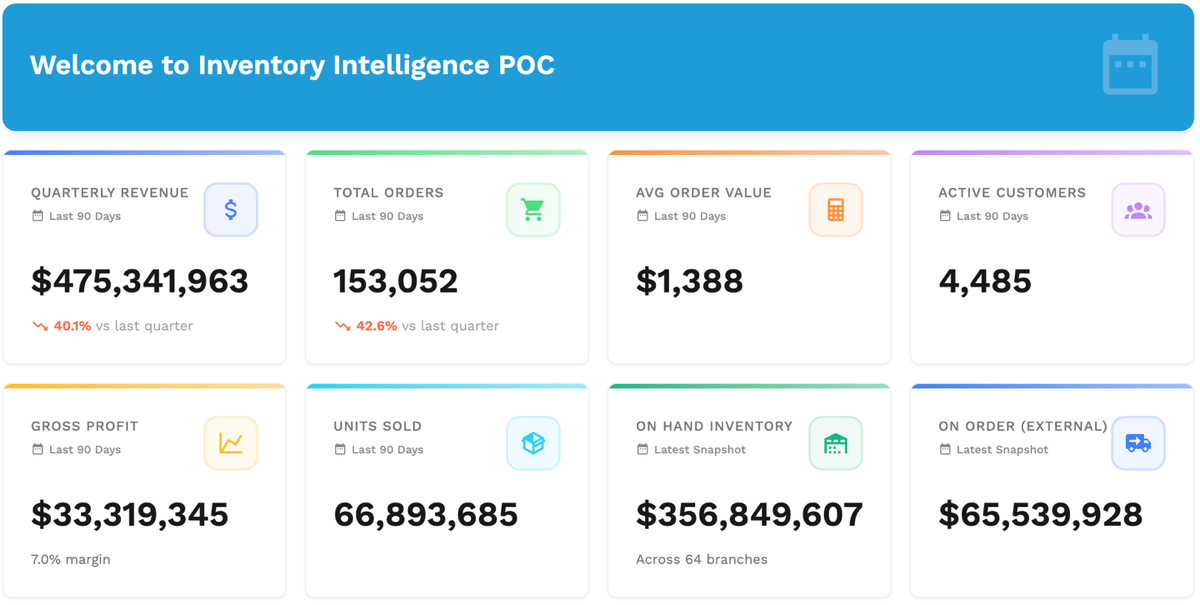
BlueLinx Inventory Intelligence Dashboard
The dashboard provides a unified view of quarterly revenue (475M), total orders (153K), on-hand inventory (356M), and external orders (65M), giving leadership immediate visibility across the entire distribution network.

2. Deadstock & Overstock by Branch

Superatom automatically identified 24.7M in deadstock and 118.6M in overstock across 57 branches.
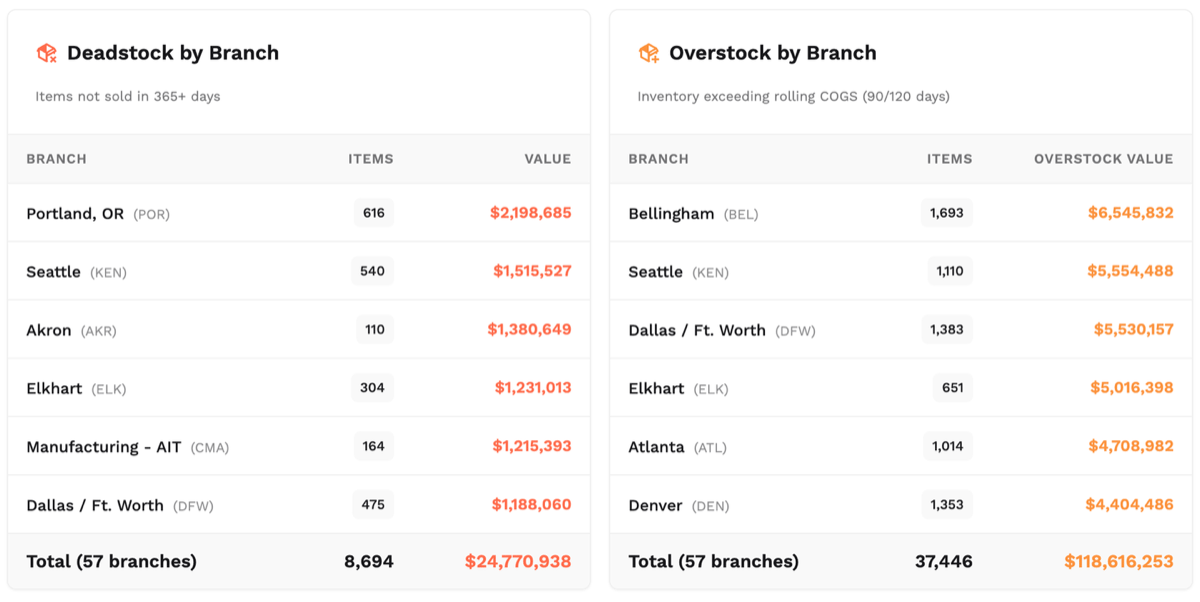
Deadstock and Overstock by Branch
Each branch is ranked by deadstock and overstock value, making it immediately clear where the largest inventory problems exist. Portland, OR leads with 2.2M in deadstock, while Bellingham leads overstock at 6.5M.

3. AI-Identified Deadstock Items

Drilling into a specific branch (Birmingham), Superatom identified 76 SKUs worth 220K with zero sales in 365+ days.
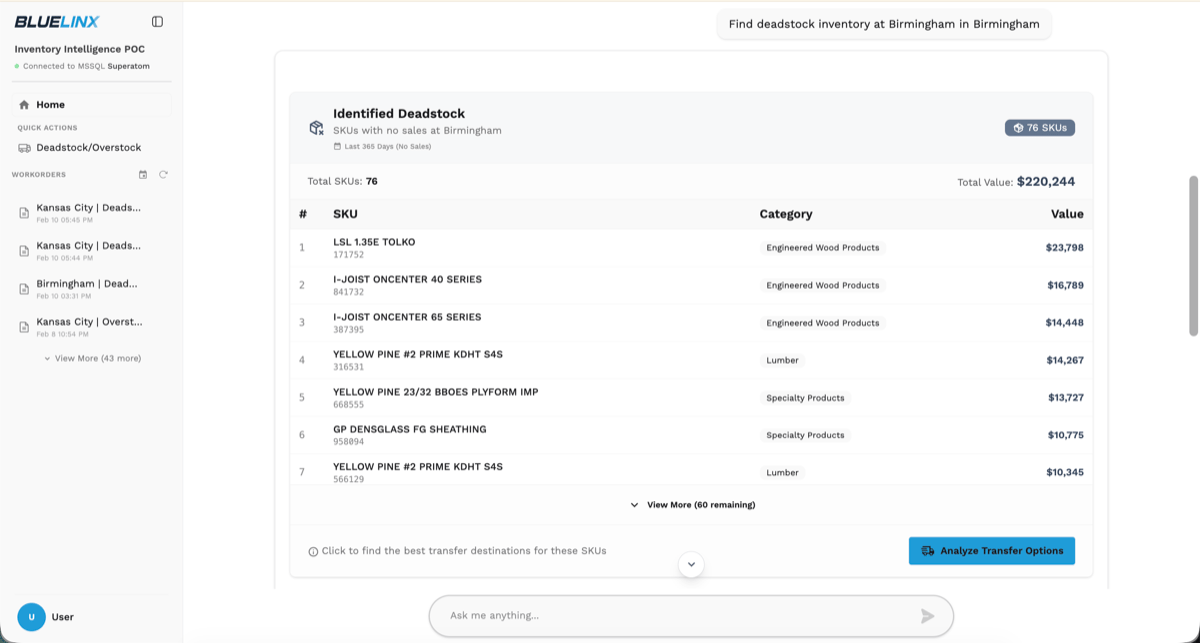
AI-Identified Deadstock Items at Birmingham
Each item shows the SKU, category, and value. The user can click Analyze Transfer Options to find the best destinations for these items using MILP optimization.

4. Transfer Optimization via MILP

Mixed Integer Linear Programming evaluates demand, distance, and freight cost to find optimal transfer destinations.
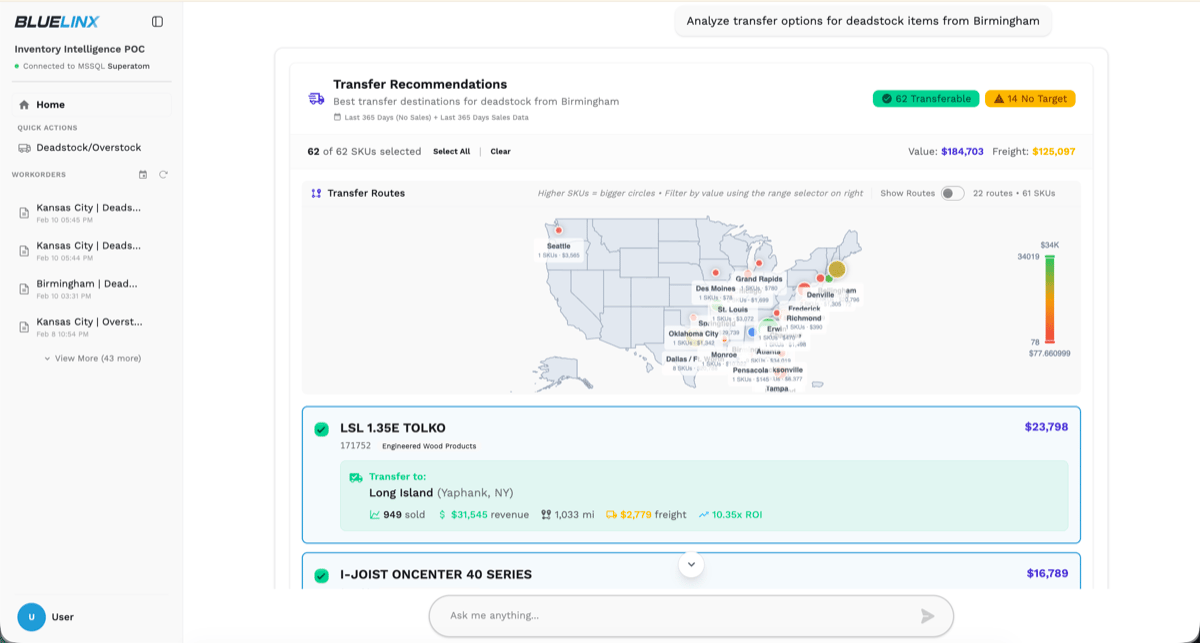
Transfer Optimization via MILP
For Birmingham’s 76 deadstock items: 62 are transferable to branches with active demand. The system computed 22 optimal routes covering 61 SKUs, with a total transfer value of 184K and freight cost of 125K. Each recommendation shows:
  • Destination branch with proven demand
  • Revenue potential based on historical sales at the destination
  • Freight cost for the transfer
  • ROI - for example, LSL 1.35E TOLKO to Long Island shows 10.35x ROI

5. Transfer Route Visualization

A geographic view of all 22 optimized transfer routes across the U.S. from a single source branch.
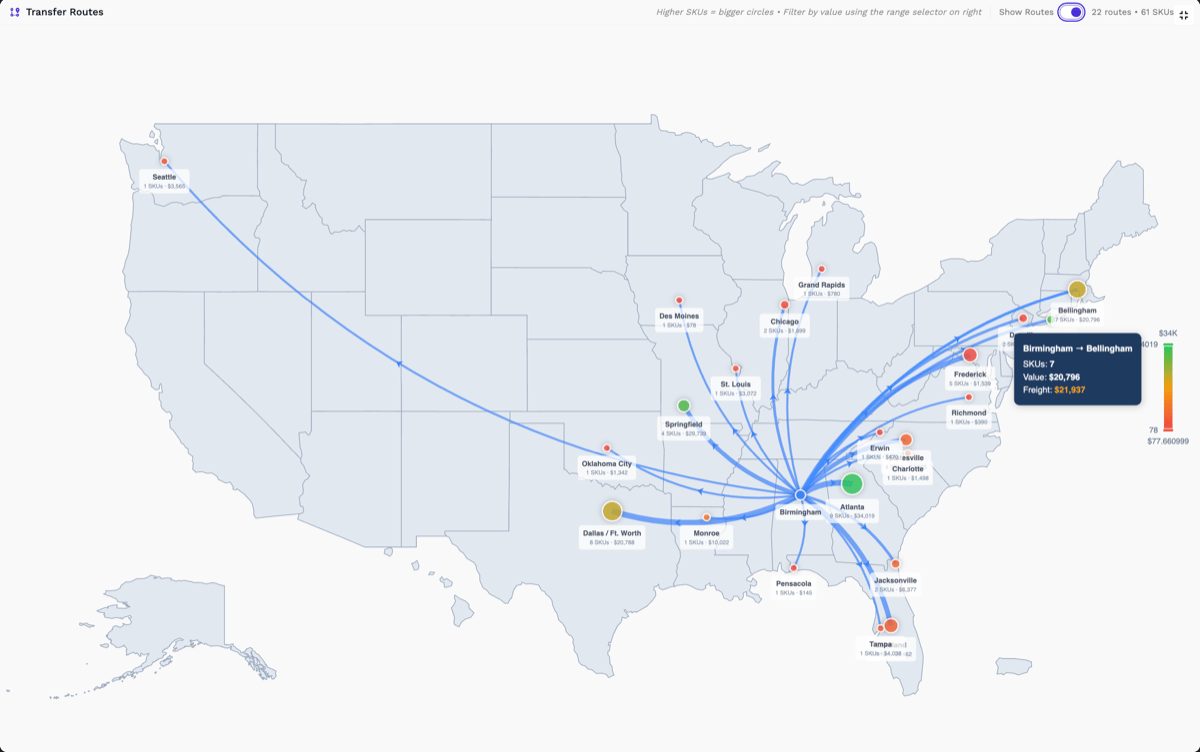
Transfer Route Visualization Map
The map shows transfer routes radiating from Birmingham to destinations across the country, each route optimized for demand match, distance, and cost. Larger circles indicate higher-value SKUs.

6. Transfer Order to Oracle ERP

From insight to action: 62 SKUs transferred to 23 destinations with a single command, written directly to Oracle ERP.
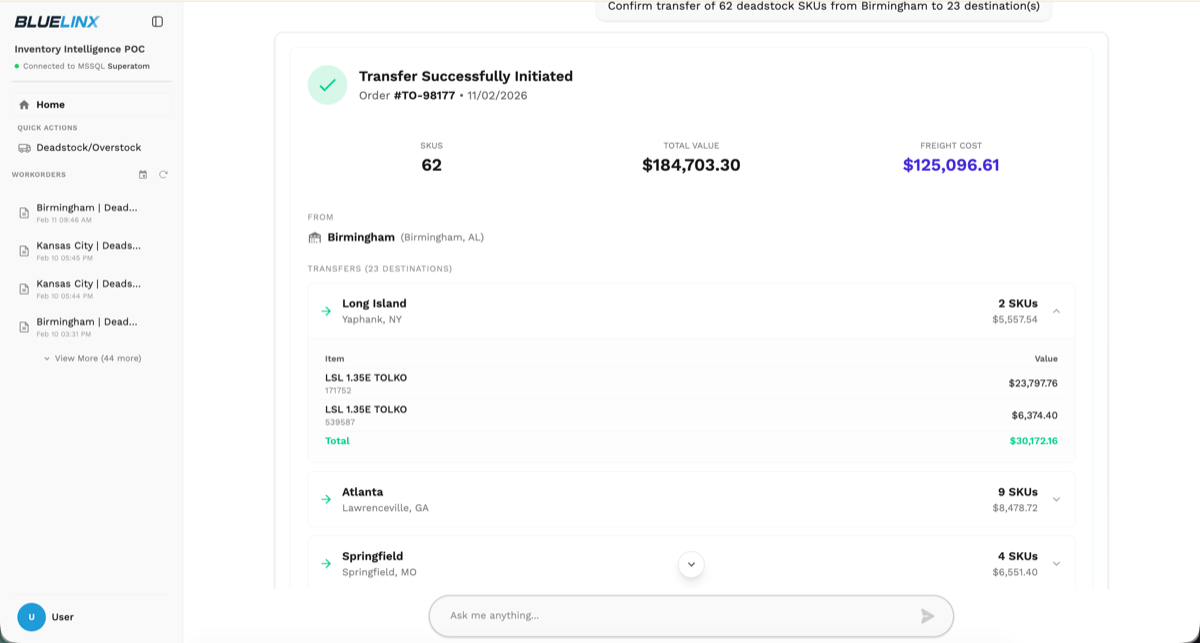
Transfer Order Written to Oracle ERP
The transfer order is created in Oracle ERP with full traceability: order number (#TO-98177), SKU count (62), total value (184K), freight cost (125K), and itemized destination breakdown. This closes the loop from AI analysis to real-world action.

Key Capabilities Demonstrated


Next Steps

Premier Energies

Plant maintenance and spare parts optimization

Use Cases

Explore more industry applications